
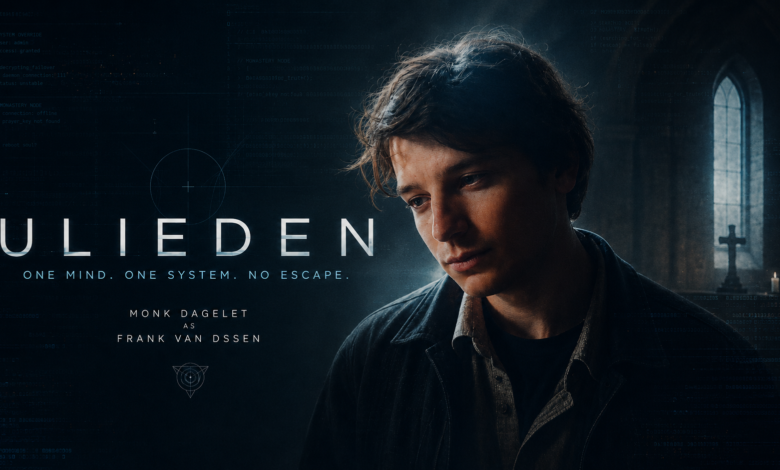
Ulieden is an upcoming Dutch web series built around one man, one hidden system, and one painful truth. Directed by Paula van der Oest, the dark thriller stars Monk Dagelet as Frank van Dssen. Frank is a gifted hacker who lives alone in an abandoned monastery near Amsterdam. He watches the outside world through hacked devices. But he may not understand the danger growing inside his own mind.
The story mixes crime, fear, grief, and modern technology. Most of the action rests on a single lead performance. That gives Monk Dagelet a hard task. He must hold the viewer’s attention while playing a man who is both hunter and possible threat.
What Is Ulieden About?
Ulieden follows Frank van Dssen, a former hacker who has cut himself off from normal life. He once exposed a secret state program. Soon after that event, he vanished from public view.
Frank now lives in an old monastery near Amsterdam. The building is empty, cold, and partly ruined. Its stone halls seem far removed from the digital world.
Yet under the chapel sits a hidden network of screens, servers, cables, and cameras.
This is where Frank spends most of his time.
He wears plain robes like a monk. He follows strict daily habits. He eats alone, sleeps little, and rarely speaks aloud. His only real contact comes through the machines beneath the monastery.
To outsiders, Frank no longer exists. Online, however, he has another name.
That name is Ulieden.
Monk Dagelet Plays Frank van Dssen
Monk Dagelet takes the lead role of Frank van Dssen. The part appears designed as a solo acting test. Frank has no close partner beside him. He does not have a normal family life or a group of friends who explain his past.
The viewer must learn about him through small details.
A shaking hand may reveal fear. A missed step in his daily routine may show that his mind is failing. A silent look toward a security camera may say more than a full page of dialogue.
Frank is not presented as a simple hero. He has skill, focus, and a strong need to expose wrongdoing. But he also spies on strangers without their consent. He enters private systems and studies people in their most personal moments.
That conflict makes him hard to judge.
He may believe he is protecting society. His actions suggest something far darker.
Why Frank Lives Like a Monk
Frank’s strange way of life is not just a visual trick. His monk-like habits show his need for order.
Every part of his day follows a fixed pattern. He wakes at the same hour. He checks the same systems. He walks through the same rooms. He sits in front of the same walls of light.
These acts help him feel safe.
They may also hide a serious mental break.
The abandoned monastery becomes a prison that Frank has built for himself. Its religious past adds another layer to the story. Frank talks about guilt, sin, punishment, and truth. He acts as if he has the right to judge others.
Yet he refuses to judge himself.
That makes Ulieden more than a hacker thriller. It is also a story about a man using rules and machines to escape his own memory.
The Secret Network Beneath the Chapel
Under the old chapel, Frank runs a huge digital watch system. It reaches into cameras, phones, home devices, private accounts, and closed networks.
Every night, he enters other people’s lives.
He watches families through security cameras. He hears private talks through phones. He reads messages that were never meant for him. He searches for signs of crime and abuse.
Frank calls the people he follows “sinners.”
At first, he may appear to have a clear goal. He wants to find people who hurt others. But his idea of guilt slowly changes. Small lies begin to look like major crimes. Angry words begin to seem like plans for violence.
Soon, Frank cannot tell the difference between real danger and the dark thoughts formed by his own fear.
The more he watches, the less he understands.
A Stranger Breaks Into Frank’s System
The central mystery begins when an unknown user enters Frank’s private network.
This should be impossible.
Frank built the system himself. He trusts no one. His files use deep layers of code and locked paths. Even skilled government teams should struggle to find him.
But the stranger moves through the network with ease.
The intruder knows Frank’s true name. They know where he lives. They know about the fire that killed his family.
Then they send him a live video from inside the monastery.
Frank studies the image. The angle is real. The room is only a short walk from his chair.
He grabs a light and searches the building.
No one is there.
The Message on the Chapel Wall
Soon after the break-in, hidden projectors begin to turn on by themselves. Large words appear across the chapel walls:
YOU DID NOT SURVIVE THE FIRE.
This message breaks Frank’s careful routine.
He checks every cable. He shuts down parts of the network. He searches for hidden doors and new devices. Nothing explains how the words appeared.
The old monastery now feels alive.
A place that once gave Frank safety becomes part of the attack. Doors seem to move. Bells ring without warning. Screens turn on after he cuts their power.
Frank starts to question his own senses.
Is someone hiding inside the building? Has the state finally found him? Or has his mind begun to create threats that are not there?
Is Ulieden a Second Hacker?
Frank begins to believe that Ulieden is no longer just his online name.
He thinks another mind may be living inside his system. This hidden figure knows his habits and memories. It can enter his files, control the monastery, and speak in his voice.
The other Ulieden appears colder than Frank.
It has deleted public records. It has changed private files. It has planted false proof against innocent people. It may also be preparing a large digital attack.
Frank tries to stop it. Yet every move he makes seems to help the hidden mind.
This creates the main fear at the heart of the series. Frank is not only fighting an unseen hacker. He is fighting a version of himself that may know his next move before he makes it.
The Fire That Changed Frank’s Life
The death of Frank’s family sits at the center of the mystery.
For years, he has treated the fire as a wound caused by others. He believes he survived a planned attack tied to the secret state program he exposed.
That belief shaped his whole life.
It gave him a reason to hide. It gave him enemies to hate. It also gave him a reason to build his spying network.
But the stranger’s messages force him to look at the event again.
His stored memories do not match the official files. Video records have missing parts. Time stamps change. Some images appear to have been made after the fire.
Frank cannot trust the government records.
Worse, he cannot trust his own.
Frank Must Hack His Own Memory
With police moving closer to the monastery, Frank turns toward the most protected part of his system.
It contains his encrypted memory files.
Frank created these files after the fire. They hold videos, voice notes, medical records, code logs, and private messages. He locked them so deeply that even he could not open them without passing several tests.
Each file brings back a piece of the past.
Some memories appear real. Others may have been changed. Frank begins to see that he used his hacker skills not only to hide from the state but also to hide from himself.
He did not merely erase records.
He built a false life around them.
The Truth About Ulieden
The main twist reveals that there was never another hacker.
Frank created Ulieden.
The second mind was not an outside user who entered his network. It was a hidden identity built by Frank to carry the weight of what he had done.
Through this identity, he could spy, punish, lie, and attack without accepting blame. Each time his actions became too cruel, his mind placed them under another name.
Frank could then see himself as the victim.
But the digital proof tells a different story.
The false files, ruined lives, and planned final attack all lead back to him. The unknown messages were created by parts of his own system. The live video came from cameras he had installed and later removed from his memory.
Even the words on the chapel wall came from his code.
Frank was both the watcher and the person watching him.
Why the Solo Performance Matters
A solo lead gives the story a tight and painful focus. Viewers remain trapped with Frank for much of the series. They hear what he hears and see what he sees.
That means they also share his doubt.
A sound in another room could mean an intruder. It could be an old pipe. It could also exist only in Frank’s mind.
Monk Dagelet must show several sides of the same person. Frank is smart but confused. He is afraid but often dangerous. He wants the truth, though he has spent years destroying it.
The role depends on control rather than large action scenes.
A quiet pause can carry fear. A sudden laugh can feel more disturbing than violence. The smallest change in Frank’s voice may show when Ulieden has taken control.
Paula van der Oest’s Role as Director
Paula van der Oest brings long film and television experience to the project. Her work has moved across drama, family stories, mystery, and psychological tension.
That background fits a story like Ulieden.
The series needs a director who can make one location feel large and changing. The monastery cannot remain a simple dark building. It must reflect Frank’s state of mind.
At one moment, it may feel like a safe home. A few scenes later, the same hall may feel narrow and hostile.
The screens also need careful use. Too much code could make the story cold. Too much explanation could slow the fear. The strongest scenes will likely focus on Frank’s face, the sounds around him, and the growing sense that he has lost control of his own creation.
Amsterdam as a Living Target
Although Frank hides outside the city, Amsterdam remains close to the story.
He watches its homes, offices, streets, and systems from beneath the chapel. The city becomes a field of small lights on his screens. Each light represents a person who does not know Frank is watching.
This creates a sharp contrast.
Above ground, Amsterdam moves through normal life. People travel, work, eat, argue, and sleep. Below the old monastery, one isolated man studies them and decides who deserves punishment.
The city may not know Frank exists until his final system begins to act.
By then, stopping it may be too late.
What Does the Ending Mean?
Near the end, church bells ring through the empty monastery. Frank sits before hundreds of glowing screens.
He has one final choice.
He can shut down the whole network and face the truth about his past. Or he can allow his hidden identity to take full control.
Then every screen turns black.
One sentence appears:
FRANK VAN DSSEN IS OFFLINE.
Outside, lights across Amsterdam begin to flicker.
The ending leaves several possible meanings. Frank may have shut down his own identity. Ulieden may have erased him. Or the attack may have already moved beyond the monastery.
The final flicker suggests that the system is still active.
Frank may be offline, but Ulieden is not.
Why Ulieden Could Stand Out
Ulieden has a focused idea. It does not need a large group of characters to create danger. Its fear comes from isolation, stolen privacy, false memory, and a man who no longer knows where he ends and his digital identity begins.
The story also touches a modern concern.
Phones, cameras, home systems, and online accounts collect parts of daily life. Frank turns those common tools into windows. He does not need to enter a home. The devices inside it invite him in.
But technology is not the true villain.
Frank is.
His machines only increase the power of the fear, guilt, and anger he already carries.
That is what gives the story weight. A normal hacker plot asks whether someone can break into a protected system. This series asks a more troubling question:
What happens when the system is a human mind?
Final Thoughts
Ulieden presents Frank van Dssen as a man divided by grief and guilt. He hides inside an abandoned monastery, watches strangers, and claims to search for evil. Yet the greatest threat has been sitting in front of his screens all along.
Monk Dagelet’s solo performance is central to the concept. The role asks him to play both victim and threat without turning Frank into a simple monster.
The result could be a tense Dutch psychological thriller about privacy, memory, and blame.
Frank built Ulieden to escape the truth. But hidden truths do not stay buried forever. They return through broken files, dark screens, and words cast across chapel walls.
And when Frank finally goes offline, the city itself begins to blink.