

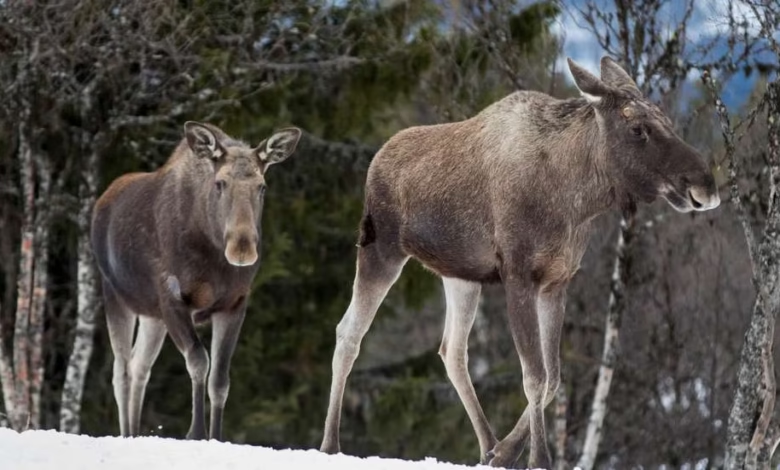
Viltnemnda is a name many people in Norway still connect with local wildlife management. For decades, these committees dealt with hunting, wildlife numbers, injured animals, and conflicts between people and wild species. The system has changed a great deal since its early years. Yet the old name remains common in many parts of Norway.
The history of these committees also tells a wider story. Norway moved from a more fixed state-controlled model to a system where municipalities have much more freedom. Some places still use a formal wildlife committee. Others use municipal staff, executive boards, or specialist fallvilt teams.
That difference can cause confusion. A person may hear that the local viltnemnd is coming after an injured moose, even when the municipality no longer has a committee with that formal name. The term has survived because people know what it means: local officials or specialists dealing with wildlife problems.
What Is Viltnemnda?
A viltnemnd is traditionally a local committee responsible for parts of wildlife management within a Norwegian municipality.
The Norwegian dictionary definition is simple. It describes the term as a municipal committee that works with wildlife management.
Historically, the committee connected national wildlife rules with local conditions. Norway has large differences in terrain, climate, farming, forests, roads, and wildlife populations. A rule that works well in one municipality may need a different local approach elsewhere.
That made local knowledge useful.
The committees often worked with hunters, landowners, police, farmers, wildlife specialists, and municipal officials. Their work could involve anything from moose quotas to an injured roe deer beside a road.
Today, the exact structure depends on the municipality.
The Early History of Norwegian Wildlife Committees
The formal viltnemnd system became an important part of Norwegian wildlife administration during the twentieth century.
According to Store norske leksikon, statutory state wildlife committees existed in all Norwegian municipalities from 1952 through 1992. Municipal councils appointed the members, but the committees formed part of the national wildlife-management structure.
This arrangement reflected the way many public services worked at the time.
National law created a common framework. Local committees then handled many practical questions close to the people, farms, forests, and hunting areas affected by those decisions.
Wildlife management was not just about protecting animals. Authorities also had to consider hunting, food resources, farming losses, road safety, forest damage, and healthy wildlife populations.
Those interests did not always point in the same direction.
A large moose population, for example, may be good for hunters. But too many moose can increase road accidents and damage young forest growth. Local wildlife management therefore became an exercise in balance rather than simple protection.
Why the Old System Changed
By the 1980s, Norway was already moving toward greater municipal control in several areas of environmental management.
A temporary legal change in 1988 allowed municipalities taking part in an expanded local environmental-management program to assume tasks that had previously belonged to their wildlife committees. Municipalities given that authority could dissolve an existing committee and transfer its work directly to the municipality.
That was an early sign of the larger reform that followed.
The main shift came through changes to the Wildlife Act in 1992. The revised law listed the municipality itself as one of the formal wildlife-management bodies. The previous section dealing with the statutory wildlife committee was repealed.
From January 1, 1993, responsibility for local wildlife management was formally transferred to municipalities.
This point matters because people sometimes say that Viltnemnda was simply “abolished in 1993.”
That is only partly correct.
The old nationwide statutory system ended. But municipalities remained free to organize local work in different ways. Some continued using committees with the same or a similar name.
Viltnemnda After 1993
After the reform, Norwegian municipalities did not all choose the same model.
One municipality might appoint a political wildlife committee. Another might place wildlife matters under an agriculture or environment department. A third might create a dedicated operational team for injured animals and road collisions.
As a result, Viltnemnda today is better understood as a local organizational model or traditional name rather than one single nationwide government body.
The variation is intentional.
Norwegian municipalities differ greatly in size. Oslo has very different wildlife issues from a small inland municipality with large forests and a high moose population.
Local governments can therefore place responsibility where it makes sense for them.
Older legal language has also changed. A 2009 regulation, for example, replaced references to “viltnemnda” with “kommunen,” or the municipality.
That change reflects how the legal responsibility shifted from one named committee to the municipality as an institution.
From Viltloven to Viltressursloven
For decades, Norway’s main wildlife statute was the Viltloven, or Wildlife Act, adopted in 1981.
Its purpose included managing wildlife and wildlife habitats in a way that protected nature’s productivity and diversity while allowing sustainable use of wildlife resources.
That law is now part of history.
A new law, the Viltressursloven, was passed by the Norwegian Parliament in 2025 and entered into force on July 1, 2026. It replaced the 1981 Wildlife Act. The government said the new statute largely continues existing principles while updating wildlife law for modern management needs.
So an article describing the current legal position should no longer present Viltloven as the main active wildlife law.
The new framework covers hunting, trapping, killing wildlife, management powers, and related responsibilities.
The Nature Diversity Act Still Matters
Local wildlife decisions do not exist in isolation.
The Naturmangfoldloven, or Nature Diversity Act, remains another major part of Norway’s environmental framework. The law took effect in 2009 and aims to protect biological, geological, and landscape diversity through sustainable use and conservation.
This matters when municipalities make decisions that affect species and ecosystems.
A local authority cannot focus only on the number of animals hunters want to harvest. It must also consider habitat, population health, biodiversity, scientific knowledge, and the wider ecological effect of its decisions.
Municipalities also have an important role in applying the principles of the Nature Diversity Act through local government decisions.
That gives modern wildlife management a much wider scope than simple hunting control.
Hunting and Population Management
Hunting remains one of the most visible parts of local wildlife administration.
Municipalities deal with issues such as hunting areas, population goals, permits, and local management plans.
For deer species such as moose and red deer, municipal authorities have formal responsibilities under national regulations. Current deer-management rules state that municipalities allocate annual hunting permits to approved hunting areas that meet the required minimum area.
These decisions can affect both wildlife populations and local communities.
Set the harvest too low, and animal numbers may rise beyond what roads, forests, or farmland can comfortably support.
Set it too high, and the population may fall more than intended.
This is why local wildlife data matters. Officials may look at hunting results, animal observations, traffic collisions, age structure, habitat conditions, and reports from hunters.
The aim is not simply to produce more animals or fewer animals. It is to keep populations at levels that can be managed over time.
The Rise of Fallviltgruppa
One of the clearest changes in modern local wildlife management is the growth of the fallviltgruppe.
“Fallvilt” broadly refers to wild animals that are found dead, injured, sick, or otherwise require special handling outside normal hunting.
Municipalities often use trained response teams for this work.
These teams may be called when a moose is hit by a car, a deer is found badly injured, or an animal escapes from the site of a collision and needs to be tracked.
The work can happen at night, in poor weather, beside busy roads, or deep in rough terrain.
Tracking dogs are often vital.
The aim is to find an injured animal as quickly as possible and prevent unnecessary suffering while protecting road users and response personnel.
Municipal wildlife funds can also be used to cover costs linked to tracking and handling injured wildlife and fallvilt.
In places where no formal Viltnemnda exists, this operational group may be the part of the system residents see most often.
Wildlife Collisions and the Role of Police
Vehicle collisions with wildlife are one of the situations where ordinary people are most likely to encounter local wildlife management.
Norwegian police make the reporting duty clear.
If you hit wildlife, you should report the incident. Police guidance says that hitting an animal is not itself a criminal offense, but failing to report the collision can be punishable. Drivers should call police on 02800, explain what happened, and follow the instructions they receive.
Police then contact the relevant local wildlife personnel and other parties when needed.
If an animal runs away after the impact, drivers should not chase it through the terrain.
Instead, the collision point should be marked as accurately as possible. A map location, GPS position, roadside landmark, or physical marker can help tracking personnel determine where the animal entered the forest.
This can save valuable time.
An injured moose or deer may travel some distance after a collision even when it has serious injuries.
Damage, Nuisance Animals, and Local Conflicts
Wildlife management is not limited to hunting and traffic.
Animals can damage crops, forests, gardens, roads, drainage systems, or other property.
Beavers are one example. Their dams can change water levels and create problems for roads or farmland. Deer may damage crops or young trees.
Local authorities may therefore become involved when wildlife creates repeated or serious damage.
But control measures are not automatic.
Officials must work within national wildlife and nature-protection rules. Depending on the species and situation, different authorities may have responsibility.
This is especially important for protected species and large predators, where decisions can involve regional or national agencies rather than only the municipality.
The local committee or wildlife team is therefore one part of a larger system.
Why Local Knowledge Remains Important
Norway’s geography explains much of the logic behind municipal wildlife management.
Wildlife conditions can change over short distances.
A coastal municipality may deal with one set of species and habitats. An inland forest municipality may face regular moose collisions. Agricultural areas may have more crop damage. Mountain areas may have other conservation pressures.
Local officials also know where accidents happen repeatedly.
They know which roads cross established animal routes. They may know where deer numbers have increased, where farmers report damage, or where hunters are seeing fewer animals than before.
National science and law set the boundaries.
Local information helps turn those rules into practical decisions.
That basic idea has remained constant even though the administrative structure has changed.
Is Viltnemnda Still an Official Norwegian Agency?
Not in the old nationwide sense.
There is no single modern state agency called Viltnemnda operating as the uniform local wildlife authority across every Norwegian municipality.
The system that existed from 1952 to 1992 ended when responsibility shifted to municipalities on January 1, 1993.
But the name did not disappear.
Some municipalities have continued to use wildlife committees or similar political bodies. Others assign the same duties to municipal departments, executive committees, or specialist wildlife-response groups.
That is why two people living in different parts of Norway may use different names for people doing very similar work.
The legal responsibility belongs to the relevant public authorities. The local organizational label can vary.
Why the Viltnemnda Name Has Survived
Government structures change faster than everyday language.
For decades, residents knew who to contact when they spoke about “viltnemnda.” Hunters used the term. Farmers used it. Police used it. Local newspapers used it.
So the name became part of ordinary Norwegian vocabulary.
Even current police guidance may use the familiar term when explaining who can be contacted after a wildlife collision. Police guidance on animal collisions states that officers can notify the viltnemnd and other relevant parties.
That does not mean every municipality maintains the same formal committee.
It means the word remains useful.
It describes a function people understand.
The Modern Meaning of Viltnemnda
The history of Viltnemnda shows how Norwegian wildlife management has moved from a uniform committee system toward local administrative freedom.
From 1952 through 1992, statutory wildlife committees formed a regular part of municipal wildlife administration. Then came decentralization. From January 1, 1993, municipalities took direct responsibility and gained more freedom to organize that work themselves.
The legal framework has continued to change. Most recently, the Viltressursloven replaced the old Wildlife Act on July 1, 2026.
But the main practical problems remain familiar.
Wild animals still cross roads. Hunters still need clear rules. Municipalities still have to manage deer populations. Farmers still face wildlife damage. Injured animals still need trained people who can respond quickly and humanely.
That is why the old name continues to carry weight.
Today, Viltnemnda may mean a formal local committee in one municipality and a broader municipal wildlife service in another. The structure has changed. The core purpose has not: managing the difficult point where wildlife, people, roads, hunting, farming, and conservation meet.